NB STORIES
Allain Has the Edge, But the NB PC Race Is Still Wide Open
The New Brunswick Progressive Conservative leadership race has reached the point where the early assumptions no longer hold up.

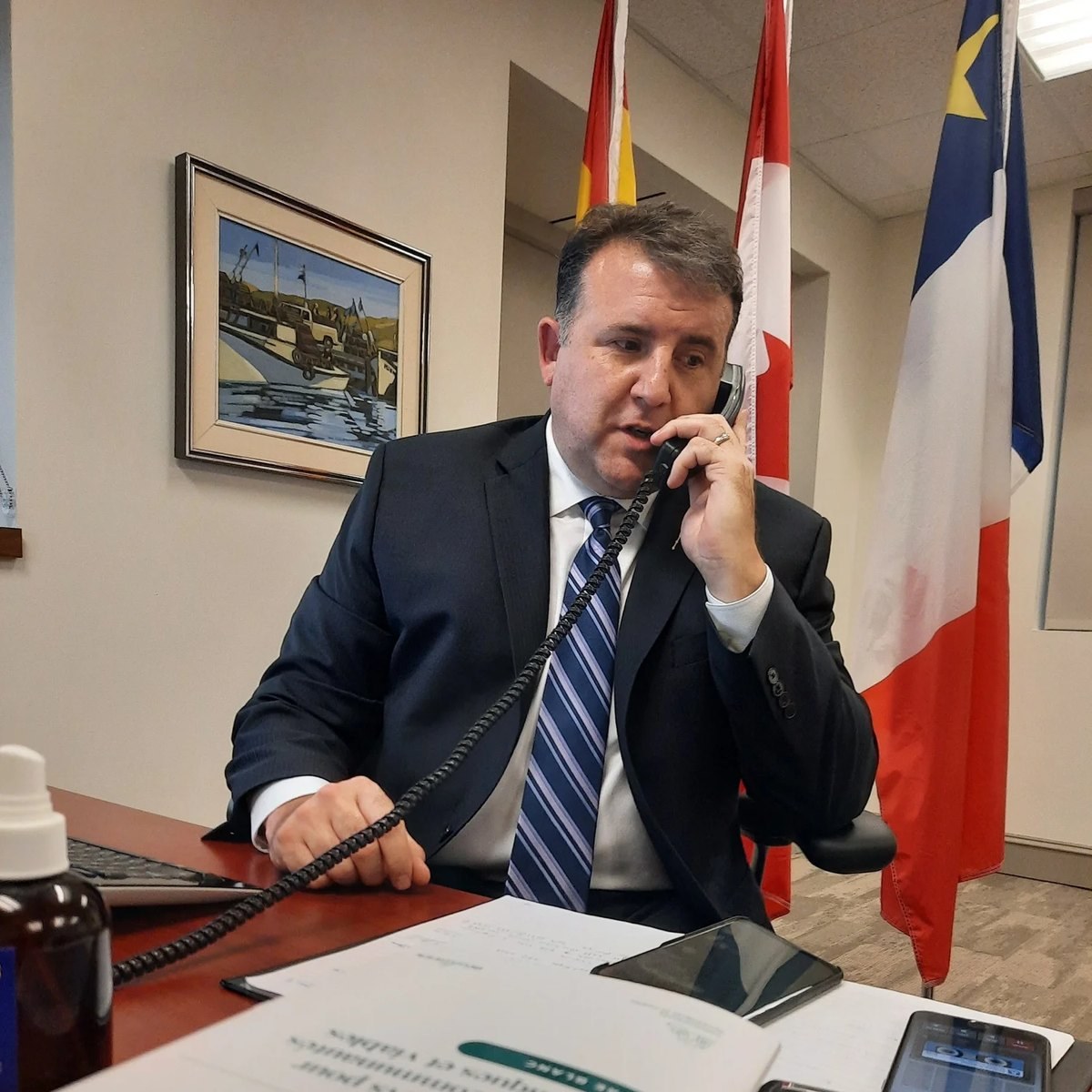
The New Brunswick Progressive Conservative leadership race has reached the point where the early assumptions no longer hold up.
Not long ago, the simple read was that Daniel Allain was the clear organizational frontrunner. He had the endorsements, the experience, and the profile of someone who has already operated at the highest levels of provincial leadership. If you were looking at the race from a distance, he appeared to be the candidate with the most complete path to both winning the leadership and taking on the Liberals.
But as the campaign has unfolded, the shape of the race has become more complicated.
Allain still appears to hold the advantage. Recent third-party research from conservative-aligned firm Clear Impact Strategy suggests he is the only candidate in the field with a credible path to defeating a Liberal government. He has the public backing of seven MLAs, including visible support from former Premier David Alward, and those endorsements have not been quiet or symbolic. They have been active, public, and reinforced through direct-to-member outreach.
At the same time, this is not a race that is locked down.
Like most modern leadership contests, this one is less about headlines and more about mechanics. Organization, turnout, and second-choice acceptability matter as much as first-ballot strength. Being the perceived frontrunner can help, but it can also create complacency among supporters who assume the outcome is settled.
That is where the race becomes more interesting.
To be clear, Allain’s position is stronger than just endorsements and polling. He has spent decades inside New Brunswick’s political and administrative systems, including leading large organizations like Alcool NB. He is running as an open book candidate, leaning heavily into accessibility, family, and transparency. His campaign has made a point of showing voters not just what he has done, but how he operates and who he is.
But even frontrunners carry questions.
First, he does not currently hold a legislative seat, which opponents have pointed to as a weakness, though that is hardly unusual in leadership races. Most recently Kerry-Lynne Findlay was elected Leader in British Columbia a few months ago without a seat. Conservative Party supporters have shown that parties are willing to choose leaders first and find them seats after – but this remains a question.
Allain has also faced criticism about his role in municipal reform, and about his vote on Motion 50 (a recommendation to ask the Child and Youth Advocate to conduct independent stakeholder consultations on Policy 713 and report back to the legislature).
Allain has rebutted that leadership requires thoughtful consultation, careful decision making, and conscientious implementation. It’s not always about following the party line, it’s about doing the right thing.
Whether that transparency strengthens him or opens space for criticism depends largely on how members interpret those decisions.
Don Monahan enters the race from a very different position.
His profile is less institutional and more outsider-adjacent. A business owner and festival operator with most of his experience coming from municipal politics in Quebec, Monahan has positioned himself as a voice for members who want a sharper break from the party’s recent direction. He has attracted support from more vocal activist circles within the conservative movement and is widely seen as closer to the harder-right base of the party.
He also carries the endorsement of former Premier Blaine Higgs, which, depending on the audience, can be either an asset or a complication given how the last election cycle ended.
But here too, the deeper you look, the more questions emerge.
The most immediate is around timeline clarity. Monahan has stated that he moved to New Brunswick in 2019, while records indicate he continued serving as a municipal councillor in Mascouche until 2021. That overlap has raised straightforward questions about residency, responsibilities, and how those roles were managed during that period. It may ultimately have a simple explanation, but to date, it has not been clearly addressed in a way that settles the issue.
Beyond that, there are broader questions about transparency that continue to circulate. Claims around his background, including references to being a veteran, have not been accompanied by detailed public explanation, leaving gaps that would normally be easy to clarify for voters seeking a full picture.
There have also been localized concerns raised online regarding business dealings, including complaints from contractors, as well as criticism around the transparency of certain events and fundraising activities connected to his orbit. None of these issues, on their own, are necessarily decisive. But collectively, they contribute to a narrative that is less settled and more uncertain.
Perhaps most interestingly his reported institutional support appears less defined. While there have been suggestions of backing from multiple MLAs, much of that support has not materialized in the same visible, public way seen on the Allain side. In leadership races, quiet support can matter, but so can the willingness of endorsers to stand up and be counted.
And that gets to the core dynamic of this race.
This is not simply a contest between two candidates. It is a test of what kind of party New Brunswick conservatives want to be heading into the next general election. A party focused on broad electability and organizational discipline, or one driven more by activist energy and ideological clarity.
Those are not mutually exclusive paths, but they do create different risks.
Allain’s argument is fundamentally about readiness and reach. He is presenting himself as the candidate who can unify caucus, appeal beyond the base, and make the party competitive province-wide. His support structure reflects that theory.
Monahan’s argument is more insurgent. It relies on mobilizing members who feel disconnected from the party’s recent direction and want a sharper contrast with their opponents.
Both paths can win a leadership race. Only one is likely to win a general election.
So where does that leave things?
Allain appears to be ahead, with the clearest path to both the leadership and a general election victory. He has organization, endorsements, and a message built around experience and transparency.
Monahan remains a live contender, particularly if he can consolidate a motivated segment of the membership and turn that energy into turnout.
But this race is not decided.
If anything, the current moment makes one thing clear: being in the lead is not the same as being safe. Leadership races are not won by reputation or assumption. They are won by ballots, and ballots only matter if they are cast.
That reality cuts both ways.
For Monahan, it means converting noise into structure.
For Allain, it means ensuring that a perceived advantage does not become a participation problem.
Because in a race like this, the biggest risk to a frontrunner is not losing support.
It is watching that support stay home.

NB STORIES
A Conservative Organizer Aims to Launch a New Centre-Right Movement in New Brunswick
A New Brunswick conservative volunteer is working to establish a new centre-right party following Daniel Allain’s PC leadership convention victory.

Organizers Pursue Registration for New Provincial Movement
Efforts are underway to establish a new centre-right political organization called The New Brunswick Party. Organizer Jason Purdy, a longtime conservative volunteer, announced the initiative following the election of Daniel Allain as leader of the Progressive Conservative Party of New Brunswick.
Elections NB spokesperson Paul Harpelle confirmed staff have answered inquiries regarding a potential new party, though no official registration documents have been submitted yet. Purdy indicated he intends to complete the necessary filings within roughly a month.
Targeting Strategic Byelections and Rural Voters
The movement’s immediate strategy involves running a candidate in an eventual legislative byelection required for Allain to win a seat. Purdy noted that the goal is either to secure the seat outright or split the vote to cause a loss, thereby prompting the Progressive Conservatives to re-evaluate their leadership. He specifically mentioned rural Anglophone voters as a primary focus for support.
Purdy’s proposed platform emphasizes fiscal accountability, responsible government, support for public healthcare alongside private options, legal abortion access, and parental rights in education. He criticized Allain’s platform as socially progressive and overly costly.
Party Leadership Distances Itself From Initiative
Progressive Conservative figures have publicly rejected the proposed breakaway effort. Allain expressed confidence in his party’s position, pointing to over 4,000 members who participated in the recent leadership vote, and stated he is not concerned about losing votes to a new group.
Other prominent party members have similarly maintained their alignment. Don Monahan stated he is 100 per cent committed to the party under Allain’s leadership and declined involvement. Progressive Conservative MLA Kris Austin confirmed Purdy remains a local riding director for now, but noted that Purdy cannot retain a director position on a PC board while building a competing political party.
NB STORIES
Why Calls for Mandatory Training for New Municipal Leaders Are Growing in New Brunswick
New Brunswick’s Local Governance Commission calls for mandatory training and free legal advice to support municipal leaders and avoid council conflicts.
Province Facing Calls for Mandatory Local Governance Training
New Brunswick’s Local Governance Commission has reiterated its demand for mandatory training for local elected officials in its latest annual report. The provincial government previously declined to implement a mandatory system, choosing instead to organize an optional two-day event in Saint John this past June.
The commission warned that the current voluntary approach fails to guarantee equal and consistent access to crucial information for all municipal leaders. It noted that standardized instruction could help prevent conflicts that have historically caused councils to disband or fall under provincial supervision.
Accessibility and Travel Costs Present Barriers for Smaller Communities
Attending in-person sessions poses significant financial and logistical challenges for resource-strapped towns. “We have communities that can’t afford lawn mowers or snow blowers,” said Union of Municipalities of New Brunswick president Brittany Merrifield, “and so it would be a real stretch for them to send an entire council to another municipality to stay for two or three days.”
Scheduling conflicts also kept some local leaders away. Grand Bay-Westfield’s mayor and six councillors were unable to attend the provincial training because it overlapped with their own pre-planned orientation. Merrifield explained, “[The province] booked their training the same weekend… We chose to attend our own because it had already been set up and we’d expended some resources to make sure that it was going to happen.”
Municipalities Seek Direct Legal and Technical Support
Provincial spokesperson Bruce Macfarlane reported that roughly 550 staff members and elected representatives attended the Saint John event. He stated that the department is reviewing the commission’s recommendations, remains open to offering guidance on request, and is scheduling additional training sessions for the fall.
Beyond formal instruction, advisory groups are pushing for free, specialized provincial assistance to interpret complex legislation like the Local Governance Act and the Regional Services Delivery Act. Dan Murphy, executive director of the municipal union, revealed that inquiries from local governments seeking advice rose by approximately 40 per cent over the past year. While experienced colleagues currently offer informal mentoring, Murphy emphasized that officials need direct support “from the people who own the legislation.”
NB STORIES
Why the Surge in Striped Bass Has Miramichi Salmon Anglers Turning to Federal Court
Miramichi salmon anglers are suing the federal government to reopen a commercial striped bass fishery, citing severe Atlantic salmon predatation.
Legal Battle Brews Over Miramichi River Ecosystem
A group of five anglers has filed a federal court lawsuit against the Department of Fisheries and Oceans, seeking to force the reopening of a commercial striped bass fishery to protect the Miramichi River’s declining Atlantic salmon. The group, which includes American camp owner Bradford Burns and angler Alex Mills, contends that an overpopulated striped bass stock is destroying the wild salmon population by preying on juvenile smolts during their spring migration to the ocean.
Federal figures show the striped bass population now exceeds 500,000, with some estimates running much higher. In contrast, adult Atlantic salmon returns on the Miramichi fell below 5,000 in 2025. Anglers argue the imbalance began after Ottawa closed the commercial bass fishery in 1996 to address collapsing bass stocks, leading to unchecked growth that has threatened the region’s historical recreational salmon industry.
Disputed Impact on Salmon Declines
DFO scientists maintain that the exact role of striped bass in salmon losses remains unclear, emphasizing that wild salmon returns are dropping globally due to broader environmental factors. DFO biologist Cindy Breau pointed to rising river temperatures caused by climate change, potential shifting ocean food chains, and tracking tags attached to young smolts as potential contributing stresses. Anglers, however, reject these explanations, pointing out that fewer than 10 percent of migrating smolts on the Miramichi reach the ocean, compared to 80 percent in neighboring rivers lacking massive bass populations.
To mitigate the predation, conservation groups including the Atlantic Salmon Federation, the Miramichi Salmon Association, and the Mi’kmaw agency Anqotum Resource Management have initiated an emergency project. Teams capture juvenile smolts upriver, tag them, and transport them downriver in tanks by truck past the dense bass concentrations. While biologists involved call it a necessary temporary measure, local outfitters acknowledge it cannot fully solve the larger population imbalance.
Tourism Conflict and Local Pivot
While salmon outfitters and guides face declining business, the boom in striped bass has created a thriving local tourism draw downriver. The annual Miramichi Striper Cup, launched in 2015, draws hundreds of competitive anglers to the city every May. The catch-and-release tournament generates substantial economic activity, though organizers and visiting anglers actively lobby against re-establishing a commercial harvest.
In response to diminishing salmon runs, historic operations along the watershed have been forced to adapt. Karl Wilson, whose family’s sporting camp dates back to 1855, noted that his business has pivoted to offering recreational tubing, corporate retreats, weddings, and bass fishing as salmon numbers remain at critical lows. Meanwhile, members of the House of Commons fisheries committee continue hearings on Atlantic salmon conservation, with regional leaders pressing Ottawa to strike a functional balance between both native species.
Your Current 3 Day Forecast — October 23, 2026
Dissident PC Member Prepares to Launch New Political Option in New Brunswick

A Conservative Organizer Aims to Launch a New Centre-Right Movement in New Brunswick

Why B.C. Lions Starters Are Resting as the Regular Season Concludes Against Winnipeg

What the Latest Strike Delay Means for the Arbec Wellness Centre Opening

Why Alberta’s Government Is Ruling Out Future Separation Votes

B.C. Supreme Court Grants Cowichan Tribes Title to Historic Richmond Lands and Fishing Rights

Vancouver Canucks Gear Up for a Make-or-Break 2025–26 Season

Land Title and Reconciliation: Canada Can’t Afford to Let Uncertainty Fester

Team B.C. Secures Margaret Todd Trophy at National Women’s Mid-Amateur Golf

Ottawa Unveils Build Canada Homes with $13B to Tackle Housing Crisis

Blue Jays Extend Win Streak, but Lose Bichette for Regular Season
-

 NATIONAL STORIES7 days ago
Why Albertans Are Heading to the Polls on the Question of Canadian Unity
-
 NB STORIES6 days ago
New Brunswick Progressive Conservatives to Reveal New Leader as Convention Concludes
-
 NATIONAL STORIES6 days ago
Decades of Western Alienation Lead Albertans to Referendum on Canada’s Future
-
LOCAL4 days ago
Your Current 3 Day Forecast — October 19, 2026
-
LOCAL6 days ago
Your Current 3 Day Forecast — October 17, 2026
-
NATIONAL STORIES5 days ago
Tragedy at CFB Wainwright frames last-minute calls for unity as Albertans prepare for referendum vote
-
LOCAL5 days ago
Your Current 3 Day Forecast — October 18, 2026
-
NB STORIES4 days ago
Why Calls for Mandatory Training for New Municipal Leaders Are Growing in New Brunswick