OPINIONS
When Politics Trump Civility: The Curious Case of the Cancelled Poilievre Luncheon


By Chad Dashly, Current News Room November 8, 2025
The Kelowna Chamber of Commerce’s sudden decision to cancel a sold out luncheon featuring Conservative Leader Pierre Poilievre has sparked confusion, and quiet frustration across the Okanagan business community.
Officially, the Chamber announced that the event was called off due to CEO George Greenwood taking an unexpected health leave. While everyone wishes him a full recovery, many longtime members have quietly asked: why did that mean the entire event had to be cancelled?
Logistics vs. Leadership: What Really Happened?
The Chamber’s capable staff and board have successfully hosted countless luncheons, forums, and policy events, often without a CEO present. The logistics of a catered luncheon are routine. So was something else influencing the decision?
When Dialogue Becomes a Liability
This issue isn’t about personalities, it’s about principles. A Chamber of Commerce exists to provide business leaders with a platform for open dialogue, especially on national policies and economic direction. Whether one agrees with Poilievre or not, hearing directly from the Leader of the Opposition on fiscal policy should have been seen as an opportunity, not a controversy.
The cancellation raises uncomfortable questions: Was there external pressure? Was the event considered “too political”? Or was the problem simply that the speaker was a Conservative?
The Risk to the Chamber’s Credibility
If ideology starts influencing which speakers are welcome, the Chamber risks losing credibility. An organization dedicated to free enterprise and civic discussion cannot afford to appear selective about political voices. The business community thrives on diverse perspectives, not silence.
For decades, the Kelowna Chamber has served as a bridge between entrepreneurs, policymakers, and the public. But bridges require balance. Filtering out certain perspectives erodes trust and inclusivity.
Reaffirming the Role of Civic Dialogue
The Chamber should embrace leaders from all political backgrounds. Poilievre, Carney, Trudeau, Singh and encourage members to engage critically. Businesspeople are more than capable of forming their own opinions without institutional gatekeeping.
As Kelowna’s economy grows more diverse and politically engaged, the Chamber now faces a choice: to retreat into partisanship or to reaffirm its role as a truly non-partisan civic forum that welcomes every serious conversation about Canada’s future.
Why This Matters for Business and Democracy
If an event cannot proceed without one individual’s presence, or if political bias determines which voices are heard, the issue isn’t about Pierre Poilievre’s welcome. It’s about whether open dialogue itself still is.
Have thoughts on this story? Share your perspective in the comments below.









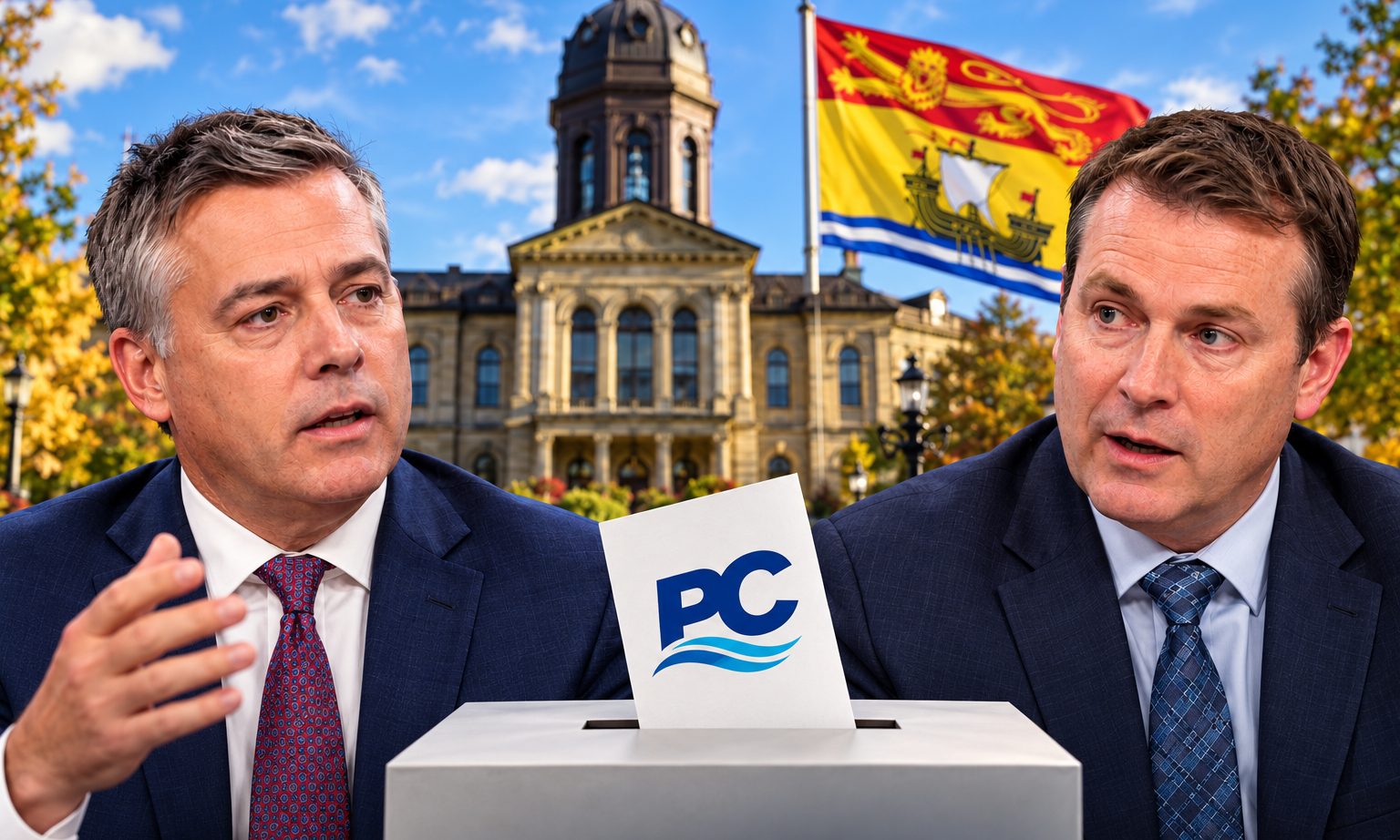
Daniel Allain and Don Monahan are heading toward an October 17 leadership showdown — but the bigger question is whether either man can rebuild a party still searching for its post-Higgs identity.
By Chad Dashly | The Current
FREDERICTON — The New Brunswick Progressive Conservative leadership race has entered its final two weeks, and this is no longer simply a contest between Daniel Allain and Don Monahan.
It is becoming a decision about what kind of Progressive Conservative Party New Brunswick will have heading toward the 2028 provincial election.
On October 17, PC members will select their new leader at the Fredericton Convention Centre. The party officially lists the leadership election for that date.
There are two candidates.
Daniel Allain is the former MLA for Moncton East and a former cabinet minister in Blaine Higgs’s government. Before elected politics, Allain accumulated extensive public- and private-sector experience, including serving as president and CEO of NB Liquor and as a deputy minister. He is fluently bilingual.
Don Monahan is the sitting MLA for Arcadia-Butternut Valley-Maple Hills and currently serves as the PC finance critic. His background includes service in the Canadian Armed Forces, two terms on municipal council in Mascouche, Quebec, and business experience after returning to New Brunswick in 2019. He is also bilingual.
But their résumés aren’t really the story anymore.
The question facing Progressive Conservatives is what they learned from 2024.
The PCs were reduced to 16 seats in that election while Susan Holt’s Liberals captured 31 and formed a majority government. Blaine Higgs subsequently resigned as leader.
Two years later, the party is still trying to determine what comes next.
The Race Is About Rebuilding
Both candidates have talked extensively about party unity and rebuilding the PC organization across the province.
During the July leadership debates, Allain argued that the party needs to compete seriously in all 49 constituencies.
Monahan made much the same organizational argument, saying the PCs need candidates nominated and working in their communities well before the next campaign. He has also emphasized returning policy development to the membership through a future policy convention.
That may sound like political housekeeping.
It isn’t.
Political parties generally don’t rebuild themselves during election campaigns. They rebuild between them — riding association by riding association, candidate by candidate and volunteer by volunteer.
Whoever wins October 17 will inherit that job immediately.
The Issues Are Bigger Than the Leadership Race
The next PC leader will also inherit a political landscape dominated by problems that have very little to do with internal Conservative politics.
An Abacus Data survey conducted July 29 to August 7 found cost of living was the leading concern among New Brunswickers, followed by health care and housing. The survey included 601 New Brunswick adults.
Those three issues should be flashing on a giant billboard outside PC headquarters.
Because leadership races can become consumed by ideological arguments, personality disputes and old grievances.
Voters usually have considerably more immediate concerns.
Can I afford groceries?
Can I find a doctor?
Can my kids afford somewhere to live?
Can businesses afford to expand?
And is the provincial government spending responsibly?
Monahan, as PC finance critic, has been particularly critical of the Holt government’s deficits and fiscal direction. He has also advocated reconsidering New Brunswick’s approach to natural gas development.
Allain has emphasized economic development and rebuilding the party’s reach across New Brunswick, while his campaign has also highlighted pressures facing small businesses, including labour shortages and rising food, wage, insurance, utility and rental costs.
Those are substantive debates worth having.
And they will matter considerably more after October 17 than another argument about who said what inside the PC Party three years ago.
The Polling Tells an Interesting Story
The most useful public snapshot of the race remains the August Abacus Data survey.
Among current PC supporters surveyed, 24 per cent preferred Allain and 13 per cent preferred Monahan, while a remarkable 51 per cent remained unsure.
Across all New Brunswick respondents, 15 per cent preferred Allain and nine per cent Monahan, while 56 per cent were unsure and 20 per cent preferred neither.
Those figures are measurements of public opinion, not a forecast of the leadership vote. The leadership electorate is PC members rather than the general population, and the survey was conducted nearly two months ago.
But the numbers reveal something potentially more important.
Neither candidate was particularly well known.
That means whoever walks onto the stage in Fredericton as leader will still have a considerable introduction to make to New Brunswick.
Watch These Dates
The biggest date is obvious:
October 17, 2026 — PCNB Leadership Election, Fredericton Convention Centre.
The voting process matters before then. Allain’s campaign information says voting is being conducted by mail and that ballots must be received by the party no later than three days before election day.
That makes the final stretch less about persuading people on October 17 and more about making sure identified supporters actually return their ballots in time.
Then comes October 18.
That might be the more important date.
The winner has to bring the other candidate’s supporters back into the tent, begin rebuilding constituency organizations, recruit credible candidates and establish an opposition agenda capable of competing with the Holt government.
And the clock immediately begins ticking toward the October 2028 provincial election, currently the next scheduled general election.
Meanwhile, the Greens Are Changing Too
The PCs aren’t the only opposition party choosing a new direction.
Green leader David Coon announced earlier this year that he would step down after more than a decade leading the party. MLA Megan Mitton subsequently entered the leadership contest, and the Greens plan to announce their new leader at their December 5 convention in Fredericton.
That means Susan Holt could soon be facing two newly installed opposition leaders.
For political watchers, that makes the next several months considerably more interesting.
The Current View
Leadership races have a habit of convincing political parties that everyone else is paying attention.
Most people aren’t.
New Brunswickers are worried about affordability, health care, housing, jobs, economic growth and the cost of government.
The Progressive Conservatives therefore have two contests in front of them.
The first ends October 17.
Daniel Allain and Don Monahan are competing to win that one.
The second is much harder.
It is the contest to convince New Brunswickers that the Progressive Conservatives have understood what happened in 2024, rebuilt themselves and are prepared to offer a credible alternative government in 2028.
That contest begins the morning after the leadership convention.
And unlike a leadership race, the electorate won’t consist of a few thousand party members.
It will be New Brunswick.
— Chad Dashly, The Current
OPINIONS
Nobody beat the B.C. Conservatives. They did it to themselves. Will N.B. Conservatives do the same?


Four weeks before New Brunswick’s Progressive Conservatives choose a leader, British Columbia has helpfully run the experiment for them
Last Friday in Vancouver, Peter Milobar became leader of a party that did not exist in the legislature two years ago. Eight more former B.C. Conservatives announced they were joining him under the CentreBC banner, three others walked out the same week, and a party that finished just three seats behind the New Democrats in October 2024 is now down to roughly twenty-five of ninety-three — with its own defectors sitting as the third-largest bloc in the chamber.
Kerry-Lynne Findlay, who won the leadership in the spring, says she is going nowhere. Premier David Eby, asked repeatedly whether he intends to call a snap election, has adopted the careful neutrality of a man trying not to smile at his own birthday party. October 24 is the date being whispered about. If it comes, the outcome is not really in doubt.
Here is the part New Brunswick should sit with.
An Ipsos poll released last week put the B.C. Conservatives at 35 per cent. At the 2024 election they took 43. That is a loss of nearly a fifth of their vote in under two years — and the New Democrats did not take a single point of it. Eby’s party is sitting exactly where it finished on election night. The eight points went to the Greens, to CentreBC, to OneBC. They went sideways, to people who mostly agree with the B.C. Conservatives about most things.
Cutting off your nose to spite your face at least leaves you with a face. This is closer to three people fighting over the steering wheel at highway speed, each of them completely certain they know the way.
What Atlantic Canada actually proves
The tempting lesson is that Progressive Conservatism is simply more popular out here, and that New Brunswick should return to the brand that works. That is half right, and the half that is wrong matters more.
In Newfoundland and Labrador, Tony Wakeham’s PCs took government last October and he now sits at 48 per cent approval — the second-highest of any premier in the country. That is a genuinely popular Progressive Conservative government, and it is a real data point.
Nova Scotia is the more instructive case, because Tim Houston is not popular. His approval sits at 37 per cent. His government’s approval is net negative. His own personal numbers are net negative. And his Progressive Conservatives are at 40 per cent and seven points clear of second place — not because Nova Scotians are delighted with them, but because the opposition to them is split between a New Democratic Party at 33 and a Liberal party at 22. Prince Edward Island has a PC government too, though the province is too small for pollsters to measure the premier separately.
So the lesson from next door is not that voters love Progressive Conservatives. In Nova Scotia they plainly don’t. The lesson is narrower, harder, and far more useful to New Brunswick: a united party beats a divided one even when the united party isn’t popular. Houston is not winning on affection. He is winning because his opponents are doing to each other precisely what British Columbia’s conservatives are doing to themselves.
Vote-splitting has no ideology. It doesn’t care which side is doing it. It just punishes whoever does.
Four weeks
New Brunswick’s Progressive Conservatives choose between Daniel Allain and Don Monahan on October 17. In the ordinary course of things, a leadership race ends with a winner, a concession, a photograph of two people shaking hands, and a party that gets on with it.
That is not obviously where this one is headed. Anyone following the argument online can see that a meaningful share of the province’s conservative movement is not discussing how to unite after the vote. Some of the loudest voices are discussing the opposite — floating, with varying degrees of subtlety, that if Monahan does not win, the answer is to go and build something else.
That is the British Columbia script. It is being read aloud here, four weeks before the vote, by people who have presumably watched what it did over there and concluded it will go differently for them.
It will not go differently for them. It never does. The mechanism is not ideological, it is arithmetic, and arithmetic is famously indifferent to how strongly you feel.
Consider where the New Brunswick PCs are starting from. In August they polled 31 per cent — below the 35 they lost with in 2024 — against a Liberal government whose approval had fallen to net negative and whose premier, Susan Holt, sits at 41 per cent. A party that cannot gain on a government going through a rough patch has a problem that no amount of ideological purification will solve. Now imagine subtracting from that 31. A conservative party at 31 that sheds five or six points to a splinter isn’t an opposition. It’s a caucus with a mailing list.
And a premier who can read those numbers is a premier who does not necessarily wait until October 2028. Holt has spent a year absorbing bad headlines about a record deficit. If her opposition spends the winter incorporating a rival party, she will have every reason to go to the polls while the spectacle is still fresh — and every reason to expect the same result Eby is about to get.
The honest version of the other argument
None of this means the insurgent side is wrong about everything, and it is worth saying so plainly.
Parties that paper over real disagreement do hollow out. There are New Brunswickers whose politics the PC establishment has treated as an embarrassment to be managed rather than a constituency to be represented, and they have noticed. A leader who wins on October 17 and then governs the party as though the other half were a problem to be waited out will deserve what follows. Nobody is owed anyone’s vote, and telling people to fall in line has never once worked as an argument.
But there is a difference between fighting for your view inside a party and leaving because you lost. The B.C. Conservatives who walked would all tell you they had principled reasons, and some of them did. They also have four per cent and two per cent between them, a leader the province views unfavourably by nearly three to one, and an NDP government about to be handed four more years by people who despise it.
Principle that produces the exact outcome you exist to prevent is not principle. It is just a more flattering word for losing.
October 18
Both campaigns will spend the next four weeks assuring members that their candidate is the one who can bring the party together. That promise costs nothing to make and tells you nothing. The real test arrives the morning after, in what the losing side does, and in what the winner does to make staying more attractive than leaving.
British Columbia has already published the results of this experiment. New Brunswick’s Progressive Conservatives are the only ones who get to read them before they sit the exam.
Susan Holt is reading them too.
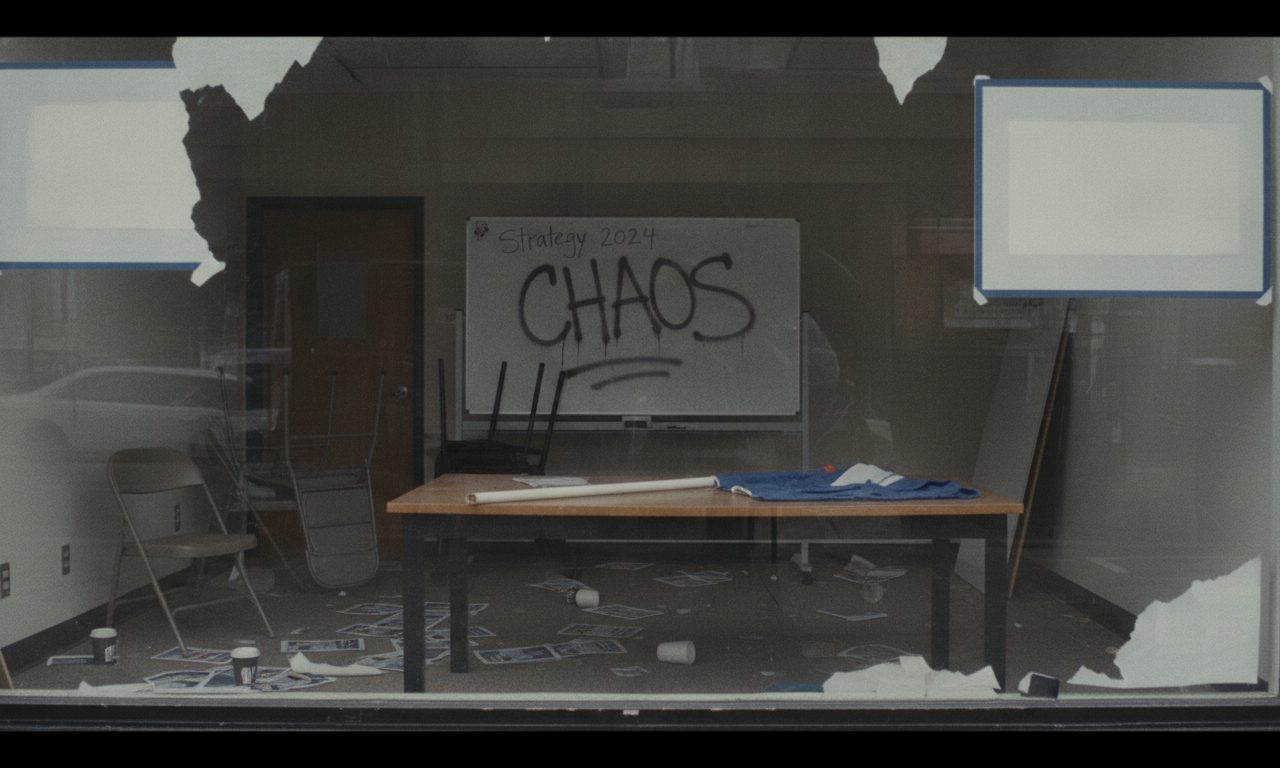
The BC Conservatives have a serious problem. But the Oremire of BC, David Eby shouldn’t start measuring the curtains for another majority just yet.
By David Chan | The Current
There is a basic lesson taught in business school that political parties occasionally forget: rapid growth can kill you almost as effectively as failure.
Growth creates complexity.
Complexity exposes weak management.
Weak management turns what looked like momentum into chaos.
Welcome to the Conservative Party of British Columbia in 2026.
When we last checked in, there were warning signs scattered around the organization. A few loose tires in the field, perhaps, but nothing you would necessarily describe as a full-blown fire.
That distinction is getting considerably harder to make.
Kerry-Lynne Findlay narrowly won the Conservative leadership on May 30 after a bruising contest against Caroline Elliott. What followed was supposed to be the relatively routine work of rebuilding a caucus, sharpening the party’s message and preparing an Official Opposition that came remarkably close to forming government in 2024.
Instead, British Columbians have been treated to one departure, controversy and internal dispute after another.
Nine MLAs have left the Conservative caucus in the recent exodus alone. The party elected 44 MLAs in 2024. It now has 28. Five former Conservatives have announced plans to operate together under a new provincial party, pitching themselves as a “stable, serious alternative” to both the NDP and the current Conservative leadership. (CityNews Vancouver)
Think about those numbers for a moment.
This wasn’t a fringe party winning a couple of accidental seats.
The BC Conservatives came within striking distance of government less than two years ago.
Today, the conversation is increasingly about whether the party can keep itself together.
That’s quite a turnaround.
And it would be a mistake to interpret all of it simply as another fight between moderates and conservatives.
Something bigger is happening.
This Looks More Like a Management Problem
Political observers naturally want to interpret everything through ideology.
Moderates versus populists.
Establishment conservatives versus grassroots conservatives.
Federal-style Conservatives versus the old BC Liberal coalition.
There is certainly some of that happening.
But ideology doesn’t adequately explain the scale of the dysfunction.
The more immediate problem facing Findlay is one familiar to anyone who has worked inside a fast-growing company: the organization expanded far faster than its internal systems.
The Conservatives scaled before they institutionalized.
In 2023, the party was effectively an insurgency.
By October 2024, it had become the Official Opposition and nearly formed government.
That’s extraordinary growth.
But gaining customers — or voters — is not the same thing as building an organization capable of serving them.
BC United’s collapse handed the Conservatives an enormous political opportunity. Voters who wanted the NDP gone consolidated behind John Rustad’s party because it suddenly became the only realistic vehicle available.
But those voters didn’t necessarily become ideological Conservatives overnight.
Neither did every candidate.
What the party assembled was an anti-NDP coalition.
That’s different from building a Conservative institution.
And now the difference matters.
A mature political organization needs candidate vetting, caucus discipline, leadership structures, professional communications, policy development, dispute-resolution mechanisms and experienced people capable of telling the leader something he or she does not want to hear.
Most importantly, it needs a culture capable of disagreement.
Because any organization large enough to govern British Columbia will contain people who disagree with each other.
That’s not a design flaw.
That’s democracy.
Nine Departures Aren’t Ideological Discipline
Findlay has a legitimate argument available to her.
Political parties should stand for something.
A caucus assembled at extraordinary speed was inevitably going to contain people with very different political backgrounds.
Some came from the BC Liberals.
Others were populists.
Some were traditional conservatives.
Others primarily wanted David Eby’s NDP defeated.
A leader is entitled to establish direction.
But there is a difference between creating ideological coherence and triggering organizational collapse.
Nine departures in a matter of weeks is a lot of coherence.
At some point, management has to enter the conversation.
The MLAs who left have offered different explanations. They have raised concerns about staffing decisions, caucus relations, ideological tests, leadership style and Findlay’s judgment.
Scott McInnis described the party as becoming an “exclusive private club” more concerned with ideological credentials than building the broad coalition required to govern.
Other departing MLAs raised concerns about reported connections involving senior appointees and Alberta separatist politics. Findlay herself has not advocated Alberta separatism, and it would be unfair to label her a separatist because of people around her.
But political leadership includes judgment about personnel.
Who gets hired matters.
Who gets fired matters.
Who gets invited into the room matters.
Who leaves the room matters even more.
When one employee quits, perhaps the employee is the problem.
When nine do, shareholders generally start asking questions about management.
Then Came the Abbotsford-Mission Mess
Findlay still doesn’t hold a seat in the legislature.
That problem appeared to be solved when Abbotsford-Mission MLA Reann Gasper resigned, clearing the way for Findlay to run in the September 26 by-election.
Gasper subsequently became Findlay’s deputy chief of staff. (Elections BC)
Legally, those facts alone establish nothing improper.
Politically, however, they are awkward.
The situation became considerably more serious when former Conservative MLA Ian Paton alleged he had been offered a paid adviser position if he resigned his Delta South seat so Findlay could run there.
Paton said the RCMP subsequently contacted him for an interview. The RCMP said it was aware of the allegations but, according to reporting, would not confirm or deny an investigation unless charges were laid.
Findlay has denied offering jobs in exchange for resignations and called the allegations baseless. No finding of wrongdoing has been made. (Conservative Party of British Columbia)
Those qualifications matter.
But politics isn’t a courtroom.
There is a difference between proving criminal wrongdoing and creating an impression of disorder.
Findlay desperately needs to move the conversation back to affordability, health care, housing, crime, taxes and the economy.
Instead, reporters keep asking about her caucus.
That’s a strategic disaster.
The Product Still Has a Market
Here is where the NDP should resist becoming too pleased with itself.
The collapse occurring across the aisle does not mean British Columbians have suddenly rediscovered their love for David Eby’s government.
Those are two entirely separate conclusions.
Recent polling has demonstrated just how volatile the province remains.
A Research Co. survey in June had the Conservatives and NDP tied at 42 per cent among decided voters. That same poll found 47 per cent of British Columbians believed the province needed a centre-right alternative to the two dominant parties. (Research Co.)
That should tell us something important.
There remains a very large market for change.
British Columbians still live with extraordinary housing costs.
Patients still struggle to access timely health care.
Families still worry about affordability.
Communities remain concerned about public safety, addiction and street disorder.
Businesses continue to complain about taxes, regulation and an economy that feels increasingly difficult to navigate.
Resource development, Indigenous reconciliation, land-use uncertainty and investment remain enormous questions.
None of that disappeared because Conservative MLAs began resigning.
David Eby’s fundamental political vulnerabilities haven’t vanished.
His opposition has simply become significantly less competent at exploiting them.
That’s not an NDP revival.
It’s an opposition failure.
There is a difference.
The New Party Could Lose Everywhere and Still Win
The creation of another centre-right party makes the mathematics even more dangerous for Findlay.
It doesn’t necessarily have to replace the Conservatives.
In fact, it could fail spectacularly by conventional measures and still transform British Columbia politics.
Under first-past-the-post, a new centre-right party polling seven or eight per cent province-wide could win very few seats.
But if those votes are concentrated among people who otherwise would have voted Conservative, it could change dozens of riding outcomes.
Imagine a riding where the NDP receives 40 per cent.
The Conservatives receive 38.
A new centre-right party takes 12.
Everyone else splits the remainder.
The new party loses badly.
The Conservatives lose narrowly.
The NDP wins comfortably.
Repeat that across enough suburban Lower Mainland, Fraser Valley, Interior and Island seats and David Eby could emerge with a significantly larger majority despite receiving little more support than before.
That is Findlay’s nightmare.
The biggest threat isn’t necessarily being replaced.
It’s being divided.
British Columbia’s political history is full of examples of what happens when the non-NDP coalition fractures.
Social Credit filled that role.
Then the BC Liberals did.
BC United attempted to continue it and collapsed.
The Conservatives inherited the market almost overnight.
Now they appear determined to reopen it.
It would be an extremely British Columbian outcome if the Conservative Party eventually succeeded in recreating the BC Liberals by driving enough former BC Liberals out of the Conservative Party.
Governing Requires People You Disagree With
This gets to the central question confronting the Conservatives.
Do they want to be a movement or a government?
Movements prize ideological consistency.
Governments build coalitions.
A movement asks: Are you one of us?
A successful political party asks: Can we work together?
Those sound similar until an organization becomes large.
Then they become dramatically different.
British Columbia isn’t Alabama.
It isn’t Alberta either.
It is a complicated province containing resource towns, union households, suburban commuters, affluent urban professionals, farmers, newcomers, First Nations communities, small-business owners and environmentally minded voters.
No centre-right party wins here by appealing exclusively to one faction.
The old BC Liberals understood that, sometimes awkwardly.
Their coalition contained federal Liberals, federal Conservatives, business conservatives, social moderates and people who simply wanted to keep the NDP out.
It wasn’t particularly elegant.
But it won elections.
Politics is ultimately a market-share business.
You can have the most loyal 28 per cent of customers imaginable and still lose to someone with 42.
Purity is considerably easier in opposition.
Government requires addition.
Abbotsford-Mission Is Now More Than a By-Election
Findlay’s September 26 contest in Abbotsford-Mission is therefore becoming a referendum on more than the local candidates.
It is the first significant market test of her leadership.
Elections BC has confirmed five candidates, including Findlay for the Conservatives and former agriculture minister Pam Alexis for the NDP. (Elections BC)
A strong Findlay victory changes the conversation.
She could reasonably argue that disgruntled MLAs and political insiders are mistaking their own unhappiness for public sentiment.
Winning decisively would put her inside the legislature, give the party a badly needed positive story and potentially stop the bleeding.
But if Abbotsford-Mission becomes unexpectedly close, things get uncomfortable.
If she loses, they become existential.
This is territory where a Conservative leader should be competitive.
The question is whether voters see the recent chaos as Victoria inside baseball or as evidence of something larger.
We’ll find out soon.
David Eby Shouldn’t Celebrate Yet
If I were advising the NDP, I wouldn’t campaign on the assumption that British Columbians have returned home.
They haven’t.
At least there is little evidence they have.
The Conservatives’ implosion provides Eby with something more valuable than renewed affection: time.
Time to repair weaknesses.
Time to improve delivery.
Time to remind British Columbians that whatever frustrations they have with his government, the alternative has to look capable of governing.
That final point may be the most important.
Opposition parties sometimes believe elections are referendums exclusively on governments.
They’re not.
Eventually voters walk into the booth and compare alternatives.
In 2024, enough British Columbians looked at the Conservatives and decided they were prepared to take the risk.
By 2026, some may be asking a different question:
Can these people manage themselves?
Because if you can’t manage 40 MLAs, voters are entitled to wonder how you’ll manage a $90-billion provincial government.
That’s the problem Findlay has to solve.
Not whether she is conservative enough.
Not whether the people leaving are moderates.
Not whether the media is being unfair.
Competence.
Stability.
Judgment.
Execution.
The boring things.
In business, those are often the things that determine whether a promising company becomes an institution or a cautionary tale.
Politics isn’t that different.
The 2024 election appeared to settle the biggest strategic question on British Columbia’s centre-right.
BC United was finished.
The Conservatives had inherited the coalition.
The NDP finally had one clear opponent.
Less than two years later, we’re back where we started.
The anti-NDP vote is still there.
The dissatisfaction is still there.
The opportunity is still there.
What isn’t clear anymore is who owns it.
And that may be the most remarkable part of the Conservative collapse.
They aren’t losing the market because British Columbians stopped wanting an alternative to the NDP.
They’re risking losing it because they have once again given those voters a reason to go shopping.
David Chan is our newest younger analytical reporter/commentator who looks at politics through management, economics, demographics and electoral strategy.
Your Current 3 Day Forecast — October 23, 2026
Dissident PC Member Prepares to Launch New Political Option in New Brunswick

A Conservative Organizer Aims to Launch a New Centre-Right Movement in New Brunswick

Why B.C. Lions Starters Are Resting as the Regular Season Concludes Against Winnipeg

What the Latest Strike Delay Means for the Arbec Wellness Centre Opening

Why Alberta’s Government Is Ruling Out Future Separation Votes

B.C. Supreme Court Grants Cowichan Tribes Title to Historic Richmond Lands and Fishing Rights

Vancouver Canucks Gear Up for a Make-or-Break 2025–26 Season

Land Title and Reconciliation: Canada Can’t Afford to Let Uncertainty Fester

Team B.C. Secures Margaret Todd Trophy at National Women’s Mid-Amateur Golf

Ottawa Unveils Build Canada Homes with $13B to Tackle Housing Crisis

Blue Jays Extend Win Streak, but Lose Bichette for Regular Season
-
 NATIONAL STORIES7 days ago
Why Albertans Are Heading to the Polls on the Question of Canadian Unity
-

 NB STORIES6 days ago
New Brunswick Progressive Conservatives to Reveal New Leader as Convention Concludes
-
 NATIONAL STORIES6 days ago
Decades of Western Alienation Lead Albertans to Referendum on Canada’s Future
-
LOCAL4 days ago
Your Current 3 Day Forecast — October 19, 2026
-
LOCAL6 days ago
Your Current 3 Day Forecast — October 17, 2026
-
LOCAL5 days ago
Your Current 3 Day Forecast — October 18, 2026
-
NATIONAL STORIES5 days ago
Tragedy at CFB Wainwright frames last-minute calls for unity as Albertans prepare for referendum vote
-
COMMUNITY3 days ago
Redeployment of Primary Care Nurse Practitioners to Emergency Rooms Raises Safety Concerns in Northern New Brunswick