HEALTH
Why Your Doctor Might Not Be the First to Hear About Your Symptoms
A survey reveals 70% of health practitioners treat patients who used AI first. NB Medical Society’s Dr. Carl Boucher shares insights on patient safety.


Rising AI Usage Among Patients
A recent survey of 682 allied health professionals across Canada, the U.S., Australia, and the U.K. reveals that 70 per cent of practitioners have treated clients who consulted artificial intelligence about their condition before their appointment. Conducted by Zanda, an Australian medical software company, the survey also noted that 33 per cent of practitioners had a client dispute their clinical judgment based on information provided by an AI tool.
Addressing the trend, Dr. Carl Boucher, president of the New Brunswick Medical Society (NBMS), noted that local physicians are increasingly encountering patients armed with AI-generated information, comparing the phenomenon to traditional internet searches.
Local Medical Society Weighs In
“While more patients are arriving with AI-generated diagnoses or treatment recommendations, the NBMS does not see this as a widespread challenge unique to the province, rather, it reflects a broader shift in how people access health information,” Boucher stated. “Informed patients can help strengthen conversations about their care; however, AI cannot replace the expertise of a physician, who considers a patient’s full medical history, examination findings, and individual circumstances.”
Boucher also cautioned patients regarding data security, noting that health data is highly sought after and advising individuals to understand privacy laws before inputting personal details into AI platforms.
Workload and Adoption Trends
The survey highlighted that AI adoption among clinicians is largely motivated by heavy administrative burdens rather than novelty. Nearly one in five practitioners (18.6 per cent) spends at least nine hours weekly on documentation alone, with 47 per cent reporting an increased workload over the past three years. Consequently, daily AI usage among physicians peaks at 32.7 per cent among those aged 50 to 59, followed by 30 per cent among practitioners under 30.
“The NBMS believes artificial intelligence has the potential to support both patients and physicians when used appropriately, but it should complement, not replace the expertise, clinical judgment, and human connection that are central to quality medical care,” Boucher added.












HEALTH
Why Emergency Rooms Across Canada Are Facing New Strains From Street Drug Additives
Canadian emergency physicians warn that medetomidine, a veterinary sedative found in illicit fentanyl, is creating complex overdoses and ER overcrowding.

Novel Drug Additive Creates Severe Hospital Strains
Emergency medical personnel across Canada are confronting heightened difficulties as medetomidine, a potent veterinary sedative, is increasingly mixed into illicit fentanyl. First identified in British Columbia, Ontario, and Quebec in 2023, the substance has spread to the Maritimes and experienced sharp rises in Saskatchewan and Yukon during 2025. Addiction medicine specialist Dr. Monty Ghosh noted that the compound alters patient care protocols by inducing deep drowsiness alongside prolonged drops in heart rate and blood pressure, restricting oxygen and blood supply to vital organs.
Complex Withdrawal Complications
Patients experiencing medetomidine withdrawal require intensive medical monitoring for severe symptoms including severe hypertension, elevated heart rate, agitated delirium, vomiting, and organ damage. Toronto emergency physician Dr. Sahil Gupta explained that these complex cases demand extended care, specialized medications, or mechanical ventilation, exacerbating emergency room overcrowding and lengthening wait times. Meanwhile, front-line nurses in B.C. and Montreal report prolonged patient unresponsiveness that requires continuous vital sign tracking.
Community Programs and Safe Consumption Debate
To reduce repeated emergency visits, Edmonton’s Bridge Healing initiative connects unhoused hospital patients to free housing and clinical care, according to Dr. Louis Hugo Francescutti. Concurrently, physicians such as Dr. Raghu Venugopal argue that supervised consumption facilities are critical to manage overdoses without overwhelming emergency wards, citing research indicating that site closures push comatose patients directly into hospital settings. Responding to the medical community’s concerns, an Ontario Health Ministry spokesperson stated the province is investing $560 million into 29 Homeless and Addictions Recovery Treatment (HART) Hubs to deliver recovery supports rather than injection sites.
HEALTH
Why Academic Experts Are Raising Concerns Over New Brunswick’s Shale Gas Survey
Academic experts call on New Brunswick to cancel its shale gas survey, citing technical errors, bias, and a lack of scientific validity in the public review.

Independent Researchers Point Out Methodology and Bias Concerns
A group of twelve independent academic researchers from the Université de Moncton and the University of New Brunswick is calling for the immediate cancellation of a public survey regarding natural gas development launched by the government on October 7. The survey was created as part of a public review examining whether to lift the province’s shale gas moratorium.
According to the scholars, the public consultation is flawed by methodology issues and technical errors that demonstrate bias in favour of lifting the moratorium. They argue that the survey lacks key safeguards required for scientific validity, such as random sampling, response limits, and protection against multiple entries or automated responses. Because anyone can complete and share the survey without demographic controls, the academics state the results will not reflect the broader public opinion of New Brunswickers.
Specific Issues Raised Regarding Question Framing
The academic team raised specific concerns about how the survey questions were constructed. They noted that Question 10 and Question 12 list positive responses, such as “Very important” and “Strongly agree,” at the top of the option lists. Standard survey research demonstrates that top options are selected more frequently, which researchers say biases responses toward ending the moratorium—a measure not explicitly named in the survey text.
Furthermore, the researchers criticized Question 13 for combining “current scientific knowledge and technologies” into a single choice. They emphasized that while modern technology improves extraction efficiency, current scientific research clearly outlines serious risks to public health, water safety, and local ecosystems. The group also noted that royalty revenues from shale gas would not reach government accounts until companies recoup initial investments after several years of operation.
Recommendations for Public Consultation
To maintain credibility during the public inquiry, the twelve researchers—including professors and graduate scholars in sociology, environmental studies, health sciences, public policy, and psychology—recommend scrapping the current poll. They suggest that the government hire an independent specialized firm if it seeks to properly gauge public opinion, while stressing that officials remain responsible for making decisions based on independent scientific analysis.
HEALTH
Uptown Saint John Office Reopens Monday After Carbon Monoxide Evacuation
A carbon monoxide leak at Cooke Aquaculture’s Saint John office sent over 20 workers to hospital on Friday. The building reopens Monday after ventilation.
Emergency Response Initiated Following Building Evacuation
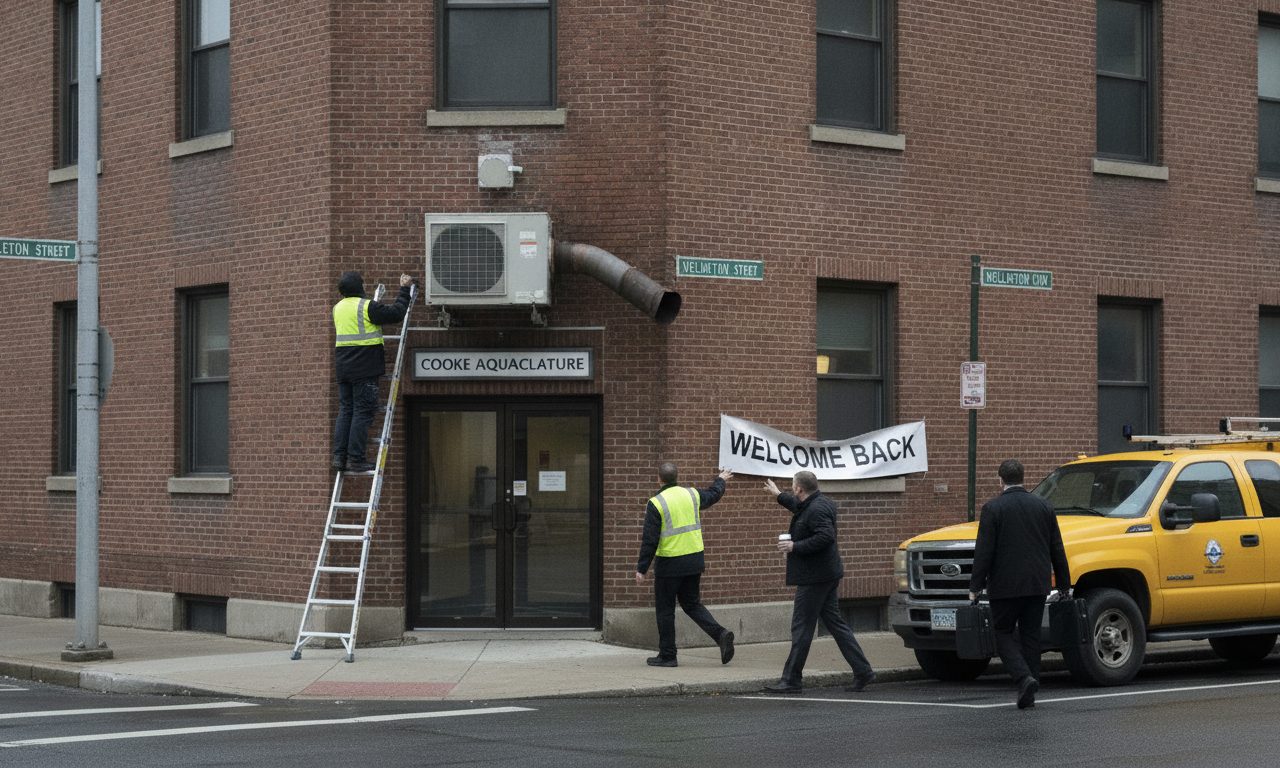
Employees at the Cooke Aquaculture office located at Carleton Street and Wellington Row in uptown Saint John are expected to return to work on Monday following a Friday afternoon carbon monoxide leak. The building was cleared by emergency crews, and staff members who received medical treatment have returned home.
Around mid-afternoon on Friday, workers on the third floor of the facility began experiencing symptoms of illness. The company promptly evacuated the building and contacted 911. Roughly 22 of the estimated 75 to 80 people working in the building needed additional attention from paramedics, with several taken to the hospital as a precautionary measure.
Hospital Protocol and Gas Leak Cause
To handle the sudden arrival of patients, Saint John Regional Hospital issued a Code Orange shortly after 4 p.m., which remained active until 8:30 p.m. Affected employees were transported to the medical facility by city bus, following standard protocols for large-scale emergency situations. Company spokesperson Joel Richardson noted that all hospitalized employees had returned home by Saturday morning and are recovering well.
An investigation by emergency responders revealed that gas escaped after a friction-fit pipe detached from the building’s furnace. “It appears that the pipe may have just vibrated loose from the furnace,” Richardson said, adding that maintenance personnel and the gas company are continuing to examine the exact cause. Fire crews ventilated the facility on Friday evening to clear the gas completely.
Preparedness and Next Steps
Richardson highlighted that recent safety exercises assisted in the smooth execution of the emergency response. “It’s very unfortunate. I mean, you never want these things to happen, but when they do, you certainly have to take them seriously and be very prepared,” he said, mentioning that a routine fire drill had taken place just days prior. Cooke Aquaculture, which has operated in the location since 2019, will continue to monitor staff health over the coming days.

Why Emergency Rooms Across Canada Are Facing New Strains From Street Drug Additives
How a New Provincial Plan Aims to Help New Brunswick Farmers Weather Climate Change

Highland Valley Copper Strike Escalates as BC Federation of Labour Issues Hot Edict

Canada’s Deepest Cave Holds Even More Mysteries, Explorers Discover

Local Author’s New Book Examines the Lives of Five Miramichi Second World War Veterans
Your Current 3 Day Forecast — November 7, 2026

Vancouver Canucks Gear Up for a Make-or-Break 2025–26 Season

B.C. Supreme Court Grants Cowichan Tribes Title to Historic Richmond Lands and Fishing Rights

Land Title and Reconciliation: Canada Can’t Afford to Let Uncertainty Fester

Team B.C. Secures Margaret Todd Trophy at National Women’s Mid-Amateur Golf

Ottawa Unveils Build Canada Homes with $13B to Tackle Housing Crisis

Blue Jays Extend Win Streak, but Lose Bichette for Regular Season
-

 COMMUNITY5 days ago
The week ahead in Miramichi: Sun 1 — Sat 7 November
-

 HEALTH6 days ago
Uptown Saint John Office Reopens Monday After Carbon Monoxide Evacuation
-

 COMMUNITY5 days ago
What to Know About the City Land Deal Supporting Miramichi’s Next Tim Hortons
-
LOCAL6 days ago
Your Current 3 Day Forecast — November 2, 2026
-

 NATIONAL STORIES6 days ago
Judge Refuses Delay for Sackville Man Seeking MAID During Murder Sentencing
-
LOCAL5 days ago
Your Current 3 Day Forecast — November 3, 2026
-
LOCAL7 days ago
Your Current 3 Day Forecast — November 1, 2026
-
LOCAL4 days ago
Your Current 3 Day Forecast — November 4, 2026